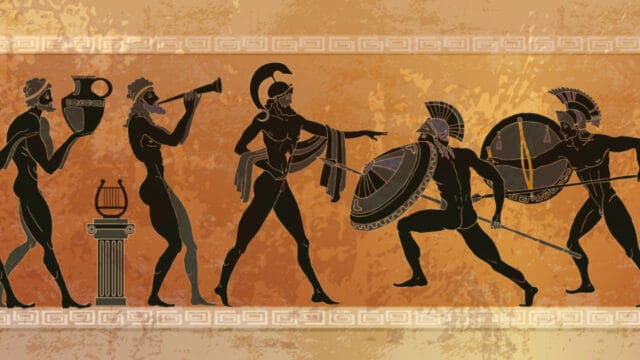
A Daemon is a semi-divine spirit, usually created when a noble person or hero dies. These beings act as intermediaries between the gods and mortals, delivering divine messages and blessings to mortals or informing the gods of their misbehavior.
What is a Daemon?

Daemons are described as spirits of the air and earth. In some texts, they are a swarm of thirty thousand magnificent beings, filling the skies between the mortal world and the divine world. In other texts, they descend from their lofty heavens and wander over the earth, where they are invisible or shrouded in mist. Occasionally, some of them, such as Agathos and Limia, may appear as snakes.
Social Status
When Cronus, the leader of the Titans, still ruled the world, he created a “Golden Race” of men. Although these men were mortal, they lived like gods, with marvelous strength, joyful feasts, and wise and pure hearts. When one of the Golden Men died, he became a Daimonion and continued to wander the earth, enjoying its blessings and watching over his future generations.
Demons played an important role during the reign of Cronus. Cronus recognized that humans are always susceptible to corruption when placed in positions of power, and that human civilization is weakened by its corrupt leaders. Therefore, he appointed Daemons as rulers of human civilization. The plan was very successful, as the most noble beings
“with much comfort to themselves and much to us, took charge of us and provided us with peace, modesty, order, and unhindered justice, and thus made the tribes of men free from strife and happy.”
Unfortunately, the fall of Cronos also resulted in the fall of this blissful social order. When Zeus took control from his father, the golden Daemones were replaced by a lesser group of “Silver Daemones.” These beings have less authority over men than their golden predecessors, but their influence remains powerful. If they catch you being cruel or unjust, they can report you to the gods for punishment. On the other hand, if they see kindness and modesty in you, they can bless you with a rich harvest.
Unfortunately, not all Silver Daemons have a noble heart. They are classified into two groups: the benevolent agatodaimons and the malevolent kakodaimons. The more evil spirits frequently abuse their power over humans, poisoning minds with lies or punishing them without reason.
Special abilities
Heavy responsibilities fall on the Daemons. Fortunately, they have several useful powers that help them do their job.
They are excellent travelers, able to disappear and reappear wherever they want. They are welcome on Mount Olympus and in the mortal world, and can even travel to the underworld and back. There are no limits to where they can go when they are needed.
As descendants of the great earth goddess Gaia, they have a natural connection to the earth. If they choose to bless their land, its crops will grow rich and bountiful. They can even save a starving man from hunger by summoning fruits from the earth.
Although spirits are invisible to humans, their presence can be felt and their voices can be heard. They are extraordinarily intelligent, even capable of predicting the future. When they have an important message to deliver, they can send it in a dream, or even whisper it directly into the heart.
Related creatures

As Christianity began to take hold of Greek and Roman traditions, Christian scholars produced several new interpretations for Daemons.
The most famous is the “demon.” Christian demons are based on Roman stories about kakodaimons, evil spirits that pursue men with bad luck and sinful impulses.
Another reworking is the “guardian angel.” Demons, which are described as semi-divine beings created when good men die, are very similar to the angels of Christianity. The common Roman belief that demons watch over us inspired the Christian belief in guardian angels, who do the same thing.
Cultural Representation
Socrates
Socrates, the father of Greek philosophy, was famous for claiming that he was born with a personal Daemon, which the gods had given him. Socrates described his Daimonion as an “inner oracle,” meaning that the spirit was part of himself, rather than a separate being. The oracle spoke whenever Socrates was about to behave badly, but when he was right, it said nothing. In this way, Socrates’ demon closely resembled today’s “conscience.”
Plato
Socrates’ most famous student, Plato, gave the Daemon a slightly new twist. Plato claimed that every man was assigned a Daemon at birth so that he would always have a noble spirit to guide and guard him throughout his life. Unlike Socrates, Plato specified that these were external beings. They were attached to men, but did not belong to men. In this way, Plato’s demon closely resembled today’s “guardian angel.”
Aristotle
Plato’s most famous student, Aristotle, continued to modify the concept of the Daemon. He gave even more power to spirits, claiming that a person’s happiness and character depended on the quality of their Daimonion. In this way, Aristotle’s demon closely resembled today’s “demons,” which can possess people and control their actions.
Aristotle passed his concept of the possessive Daimonion on to Alexander the Great, one of his students. When Alexander rose to power, he encouraged his subjects to worship his Daimonion instead of him. This tradition continued well into the height of the Roman Empire, with glorious dæmons such as “Augustus” being recycled among leaders and exalted by the public.
The modern demon
Today, demons are rarely discussed in public. They have been replaced by similar concepts, such as conscience, guardian angels, or the devil.
However, these beings remain popular in spiritual and psychological circles. They are discussed in Buddhist texts and in the writings of Carl Jung. Most scholars today have returned to a Socratic interpretation of demons; they believe that spirits symbolize qualities that belong to humans, such as our intelligence and morality, and that their voices are really just a part of us.