Daedalus was a scientist in Greek mythology. His name means “cleverly crafted,” related to the phrase “to work ingeniously” or “of knowledge.” In Latin, “Daedalus Etruscan” means craftsman and artist, and he was seen as a symbol of wisdom, knowledge, and power.
1. Mythological Origin
He is the father of Icarus, the uncle of Perdix, and possibly also the father of Iapyx, although this is unclear. He invented and built the labyrinth for King Minos of Crete, but shortly after completing it, King Minos had Daedalus imprisoned inside the labyrinth.
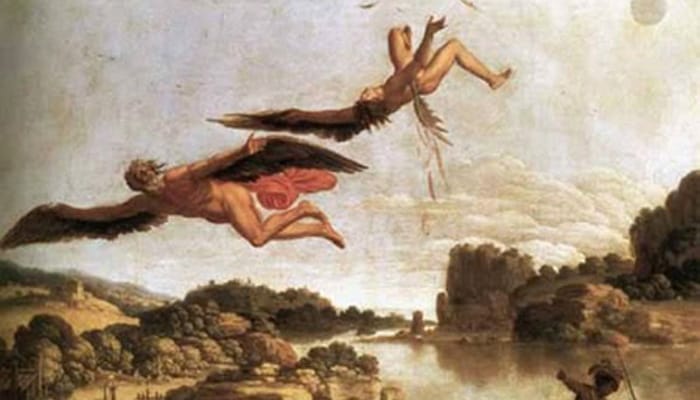
He and his son Icarus devised a plan to escape using wings made of wax that Daedalus had invented. They escaped, but sadly, Icarus did not heed his father’s warnings and flew too close to the sun. The wax melted and Icarus fell to his death. This left Daedalus heartbroken, but instead of giving up, he flew to the island of Sicily.
Daedalus
Daedalus was a craftsman and artist in Greek mythology who had two sons, Icarus and Iapyx. He is best known as the creator of the Labyrinth, a huge maze located beneath the court of King Minos of Crete, where the Minotaur, a creature half bull and half man, lived.
According to the myth, the king of Athens was forced to pay tribute to King Minos by sending seven young men and seven young women to Crete each year to be sacrificed to the Minotaur. One year, however, the legendary hero Theseus was sent to the labyrinth and managed to kill the Minotaur, assisted by Minos’ daughter, Ariadne.
Later, Daedalus was imprisoned in a tower in Crete so that the secret of the labyrinth would not be revealed to the public. To escape, Daedalus created two sets of wings for himself and his young son Icarus, using feathers and wax. He gave one of the sets to Icarus and taught him to fly.
They left the tower by jumping out of the window and began to fly towards freedom. Unfortunately, Icarus, forgetting his father’s advice, began to fly higher and higher, causing the wax on his wings to melt. He fell into the sea and drowned, while a nearby island took the name Icaria in his honor.
Daedalus finally arrived on the island of Sicily, where he was welcomed at the court of King Cocalus. There, he built a temple in the name of Apollo and offered his wings to the god. Meanwhile, Minos had begun a search for Daedalus. Going from place to place, he asked if anyone could solve the riddle of running a string through a spiral shell.
When he went to Sicily, Cocalus knew that Daedalus could solve the riddle and asked him to do so. Daedalus took an ant and tied the string to it, then lured it into the shell with a drop of honey. Cocalus told Minos that he could relax and take a bath first; when Minos entered the bath, Cocalus’ daughters killed him.
Family
Daedalus’ parentage was provided as a later addition, giving him a father in Metion, Eupalamus, or Palamaon, and a mother, Alcippe, Iphinoe, or Phrasmede. Daedalus had two sons, Icarus and Iapyx, along with a nephew, Talos or Perdix.
The Athenians transferred Cretan Daedalus to make him born in Athens, grandson of the ancient king Erechtheus, claiming that Daedalus fled to Crete after killing his nephew Talos. Over time, other stories were told about Daedalus.
Daedalus and Icarus. The most familiar literary account explaining Daedalus’ wings is late, that of Ovid: in his accounts found in the middle of the century (VIII: 183–235), Daedalus was locked in a tower to prevent knowledge of his Labyrinth from spreading to the public. When the work was finished, the artist, flapping his wings, found himself floating upward and hanging suspended, positioning himself in the beating air.
The lament for Icarus
They had passed Samos, Delos, and Lebynthos when the boy, forgetting himself, began to rise toward the sun. The burning sun softened the wax that held the feathers together, and they fell off. Icarus fell rapidly into the sea and drowned. Some time later, the goddess Athena visited Daedalus and gave him wings, telling him to fly like a god.
The image of Daedalus with wings appears on an Etruscan jar from 630 BC found in Cerveteri, where he appears with a winged figure with captions on one side of the vessel, paired on the other side, uniquely, with Metaia, Medea. Magically, Daedalus could fly, and magically Medea could rejuvenate (the scene on the jar seems to show her doing just that). The image of Daedalus shows that he was already well known in the West.
2. Mythologies
The myths surrounding the figure of Daedalus are based on enormous, ingenious, and modern constructions such as the labyrinth located beneath the court of King Minos of Crete, where the Minotaur, a creature half man and half bull, lived. According to the myth, the king of Athens was forced to pay tribute to King Minos by sending seven young men and seven young women to Crete each year to be sacrificed to the Minotaur.
The labyrinth
Daedalus is first mentioned by Homer as the creator of a large dance floor for Ariadne. He also created the Labyrinth in Crete, where the Minotaur (part man, part bull) was kept. In the story of the labyrinth told by the Hellenes, the Athenian hero Theseus is challenged to kill the Minotaur, finding his way with the help of Ariadne’s thread. Daedalus’ appearance in Homer’s narratives is found in an extended metaphor, “clearly not an invention of Homer.
In Homer’s literary language, daidala refers to finely crafted objects. Most are items of armor, but fine bowls and furniture are also daidala, and on one occasion so are the “bronze brooches,” “twisted brooches, earrings, and necklaces” made by Hephaestus while being secretly cared for by the sea goddesses.
Ignoring Homer, later writers thought of the Labyrinth as a building instead of a single dance path to the center and back out again, and gave it tons of winding passages and twists that opened into each other, so it seemed like it had no beginning or end. Daedalus built the labyrinth for King Minos, who needed it to imprison his wife’s son, the Minotaur.
The story goes that Poseidon had given Minos a white bull to use as a sacrifice. Instead, Minos kept it for himself; and in revenge, Poseidon, with the help of Aphrodite, made Pasiphaë, King Minos’ wife, feel sexual desire for the bull.
As interpreted by Greek mythologists, Daedalus also built a wooden cow so that he could mate with the bull, since the Greeks imagined that the Minoan bull of the sun was a real, earthly bull, whose slaying required a heroic effort by Theseus.
This story therefore encourages others to consider very carefully the long-term consequences of their own inventions, to prevent those inventions from doing more harm than good. As in the tale of Icarus’ wings, Daedalus is portrayed as helping to create something that has negative consequences later on, in this case with his work on the almost impenetrable labyrinth of the monstrous Minotaur, which made killing the beast a task of legendary difficulty.
Sicily
Daedalus arrived safely in Sicily, under the care of King Cocalus of Kamikos, on the southern coast of the island. There, Daedalus built a temple to Apollo and hung his wings as an offering to the god. In an invention of Virgil (Aeneid VI), Daedalus flies to Cumae and founds his temple there, instead of Sicily; much later, Aeneas faces the carved golden doors of the temple.
He presented a spiral shell and asked for a string to be passed through it. He tied the string to an ant which, attracted by a drop of honey at one end, walked through the shell that crossed it. In some versions, Daedalus himself poured boiling water on Minos and killed him.
The anecdotes are literary and late; however, in the founding tales of the Greek colony of Gela, located in the 680s on the southwestern coast of Sicily, the tradition was maintained that the Greeks had taken cult images made by Daedalus from their local predecessors, the Sicani.
Daedalus and his cousin Perdix
His sister had placed her son, variously named Perdix, Talos, or Calos, in his care to be taught mechanical arts. The nephew was a scholar of art and showed surprising evidence of ingenuity. Walking along the seashore, he picked up a fishbone.
According to Ovid, imitating him, he took a piece of iron and inserted it into the edge, thus inventing the saw. He put two pieces of iron together, connecting them at one end with a rivet and sharpening the other ends, and made a pair of compasses. Athena turned Perdix into a partridge and left a scar that looked like a partridge on Daedalus’ right shoulder, and Daedalus stopped serving Athena because of this.
3. Daedalus’ Innovation
Vital details such as these were embroidered into Daedalus’ reputation as an innovator in many arts. In Pliny’s Natural History (7.198), he is credited with the invention of carpentry “and with it the saw, the axe, the plumb line, the drill, the glue, and the pile of stones.” Pausanias, traveling through Greece, attributed to Daedalus numerous archaic wooden cult figures that impressed him: “All the works of this artist, though somewhat crude to look at, nevertheless have a divine touch about them.”
It is said that he first conceived masts and sails for ships for the navy of Minos. It is also said that he sculpted statues so well that they seemed alive; they even moved on their own. They would have escaped if it weren’t for the chain that tied them to the wall.
In Platea there was a festival called “the Daedala,” in which a temporary wooden altar was designed, and an effigy of an oak tree was made and dressed in bridal attire. It was carried on a cart with a woman acting as a bridesmaid. The image was called Daedale, and the archaic ritual was given an explanation through a myth for the purpose.
In the Romantic period, Daedalus came to denote the classical artist, a skilled mature craftsman, while Icarus symbolized the Romantic artist, whose impetuous, passionate, and rebellious nature, as well as his defiance of formal aesthetics and social conventions, can demonstrate this. Being self-destructive in Stephen Dedalus’s story and in Joyce’s Portrait of the Artist show him as a young man who imagines his artistic future with this thought: “a winged shape flying over the waves, a man like a falcon flying towards the sun over the sea, a prophecy of the end that had been born,” “to serve.”
The Statues of Daedalus
It is said that Daedalus created statues that were so realistic that they had to be tied down to prevent them from walking away. Socrates and Meno are debating the nature of knowledge and true belief when Socrates refers to Daedalus’ statues: “if they are not tied down, they look absent and flee; but if they are tied down, they stay where they are.”
