Chiron is a wise and noble centaur, often entrusted with the young heroes of Greek mythology. With his many talents and kind nature, he can train heroes in everything from the deadly arts of hunting and archery to the delicate arts of music and healing.
Physical Description of Chiron
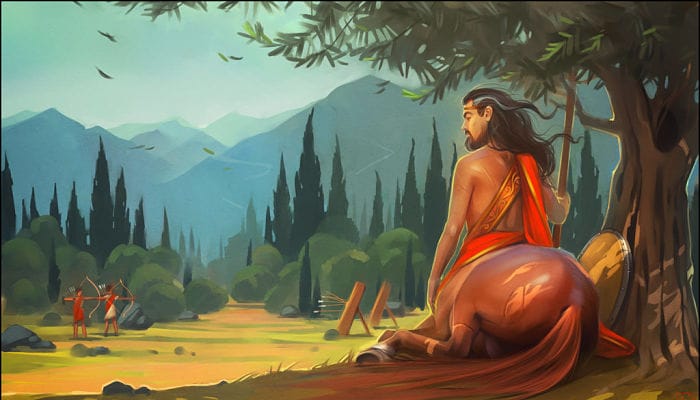
Chiron is described as a centaur, a creature with the head and torso of a man merging into the powerful body of a horse. However, the nobility of his spirit easily outshines the other centaurs, and his appearance shows telltale signs of his superiority.
Unlike other centaurs, who have four horse legs, Chiron’s front legs are human and his hind legs are horse legs. His face is an image of strength and classical beauty, without the pointed ears and wild hair that give other centaurs a mischievous look, and he often wears clothing, including laurel wreaths, which show how civilized he is compared to his brothers.
Chiron’s personality
Of all the characters in Greek mythology, Chiron has perhaps the purest and most selfless heart. You will never find him involved in the tricks or disputes of the other immortals; his dignity keeps him above their schemes.
First and foremost, this magnificent centaur has the heart of a teacher. He is incredibly intelligent and clear-sighted, but he is also humble and loving. This rare combination makes him a highly sought-after instructor, but he welcomes everyone into his home, no matter how weak or humble they may seem.
Everyone who leaves his home, after living under his care and guidance, is stronger and wiser than when they arrived. Second, he is brave and self-sacrificing. He risks his life for his friends and students on multiple occasions, and ultimately decides to sacrifice his immortality to save someone else’s life.
Special abilities of Chiron
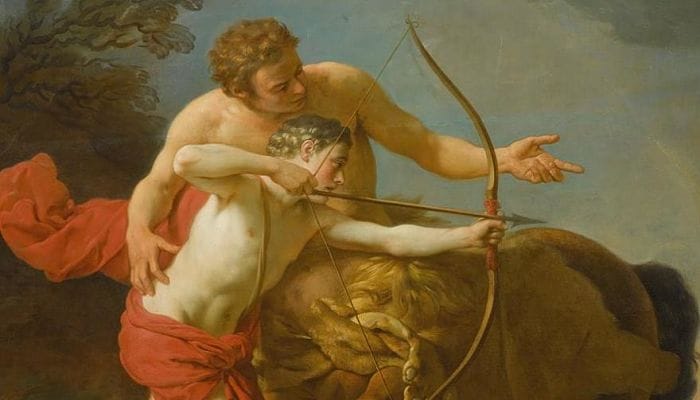
Chiron is a talented archer, hunter, musician, oracle, and healer. His skill with the bow and arrow is unmatched, although his pupil Achilles became a sporting rival. His favorite instrument is the lyre, which he plays perfectly, even by Apollo’s standards. As an oracle, he has knowledge of hidden secrets and future events, which he demonstrated when he told Peleus how to make the stunningly beautiful sea nymph Thetis his wife.
However, the most prolific talent of the powerful centaur is his ability to heal. He knows all the herbs that grow in the pristine forests of his home on Mount Pelion, and he can use them to great effect. He has healed many deep wounds for his students, but his most famous achievement was restoring sight to Phoenix, a hero who had been blinded.
Creatures Related to Chiron
Chiron’s lineage is different from that of the other centaurs, which may explain some of the differences between them. His father was Cronus, one of the original Titans who ruled before the gods, and his mother was Filira, a beautiful ocean nymph. Unfortunately, Cronus and Filira were caught in the middle of their encounter by Rhea, Cronus’ wife. Heartbroken, the Titan turned into a stallion and galloped away.
Months later, when Philyra gave birth to her son, the baby was half horse. Filyra rebelled against her son’s monstrous form; she abandoned him and begged the gods to transform her into another form, so that she could forget her misfortune. The gods turned her into a lime tree.
Poor Chiron was left an orphan, but luck quickly turned in his favor. The radiant god Apollo found the baby and decided to take him in as his own son. He taught the orphan how to suppress his animal instincts and live nobly, in a way that highlighted his humanity, even his divinity. Apollo also taught the young centaur about music and medicine. Apollo’s twin sister, Artemis, approved of his plan and decided to take on the role of the orphan’s adoptive mother. She taught him archery and hunting.
After growing up, the orphan made his adoptive parents proud by becoming a revered teacher. He was always eager to repay the kindness Apollo and Artemis had shown him, and he took on many young students of his own, including Achilles, Ajax, Heracles, Jason, Peleus, Perseus, and Theseus.
In addition to his students, the centaur had his own biological children. He married a nymph named Chariclo, and with her he had three daughters, Melanippe, Endeis, and Ocyrhoe, and a son, Carystus.
Cultural Representation of Chiron
Chiron appears in the epic poems of ancient Greek writers, including Ovid, Pindar, Homer, and Hesiod, dating back to the 7th or 8th century AD.
However, some scholars believe that this unusual centaur may have had a pre-Greek origin, which could explain some of the peculiarities that set him apart from traditional Greek centaurs. He may have been a god of Thessaly, the nation that surrounded Chiron’s legendary home, Mount Pelion, before it was conquered by the Greeks.
Famous myths about Chiron
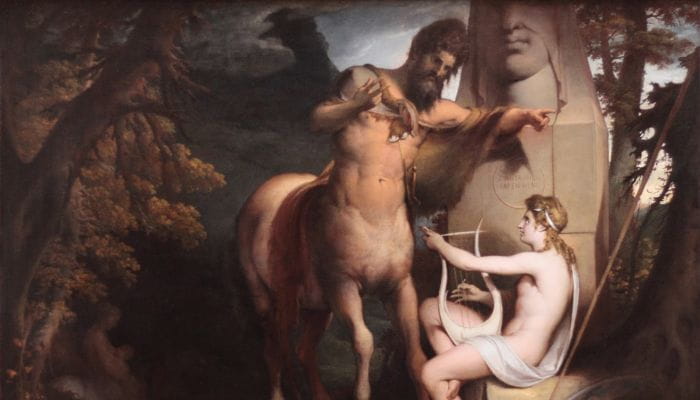
The life of Chiron is well documented by Greek poets and scholars. There are stories of every chapter of his life, from his unlikely conception and birth to his heartbreaking death.
The centaur’s relationship with Peleus, a Greek king and hero, winds a long thread through his legendary life. Their story began when Peleus and his friend, Acastus, went hunting in the wilderness. Unbeknownst to Peleus, he was traveling with a traitor; Acastus was plotting against Peleus’ life because his wife had fallen in love with the new hero. The two friends lay down to take a nap, but when Peleus awoke, both Acastus and his sword were gone.
Peleus was defenseless and would have died if Chiron had not found his sword, returned it to him, and taken care of him until he returned home. Later, Peleus returned to consult the centaur, whom he considered a good friend, about a new problem: he was desperately in love with an ocean nymph, Thetis, but did not know how to win her as his wife. Chiron told him where he could find the nymph and how he could win her as a bride, and with the centaur’s guidance, he succeeded.
The couple even celebrated their wedding, a lavish event attended by many of the gods, in Chiron’s cave on Mount Pelion. Later, Peleus sent his only son, Achilles, to be taught by the centaur.
Another important relationship in Chiron’s life was with his daughter, Melanippe. Among all his daughters, Melanippe was the most beautiful and gifted. She was deeply prophetic and liked to predict the fate of the young heroes who passed through her father’s cave. She even predicted the death of her own father, although the vision caused her enormous pain (according to some legends, she grieved so much that she died and became an image in the stars).
Although she was intelligent, Melanippe could not resist Aeolus, grandson of Zeus and son of the most legendary beauty of the Greeks, Helen, when he came to the desert to woo her. She soon became pregnant with Aeolus’ son and fled home to hide her pregnancy from her father, who had raised all his daughters as virgins dedicated to Artemis. Chiron went to look for his daughter, and she begged the gods to hide her somehow. So they transformed her into a black mare so that she could give birth. After giving birth, she passed into the stars.
The story that ended Chiron’s wonderful life shows the culmination of his kindness. Another Greek hero, Heracles, was visiting his cave, and the two adventurers began to examine Heracles’ weapons. Heracles was eager to show off a set of arrows, poisoned with the venom of the monstrous hydra, which he had recently killed.
By a strange accident (some myths say that Chiron dropped one of his arrows, others that Heracles accidentally dropped it while testing his bow), Chiron was pierced by one of the poisoned arrows. The wound did not kill him because he was immortal, but it caused him terrible and debilitating pain. Surprisingly, the wounded centaur was not angry with Heracles. Instead, he tried to comfort the young hero, who was horrified by what he had done to such a great teacher.
After days of suffering, the centaur devised a plan to ease his pain and Heracles’ guilt; he volunteered to help Heracles complete his final great task, freeing Prometheus, which required an immortal life to be sacrificed for him. Thus died the wise and gentle teacher, who had trained so many Greek heroes, and Heracles was able to free Prometheus. As a token of their admiration for this final heroic act, the gods placed the centaur in the sky as a constellation.
Visual Arts
Early Greek pottery is full of images of Chiron and his students, especially Achilles. In these early images, the noble teacher appears as in the epic poems; he has a human body, complete with two human legs, and the hindquarters of a horse are attached to his waist. In later Greek art, he began to look more like a centaur, with four horse legs, and by the time he was adopted by the Romans, he had permanently lost his human legs, although he still wore capes and laurel to symbolize his nobility.

