Capricorn means “the goat” in Latin. The constellation Capricorn is located in the fourth quadrant of the southern hemisphere and is specifically found between latitudes +60° and -90°. Like all signs of the zodiac, Capricorn was first catalogued in the 2nd century by Ptolemy, who was a Greek astronomer.
How to see the constellation Capricorn

The constellation Capricorn, the sea goat, is best seen in the early evening in September and October. If you live in the Northern Hemisphere and are familiar with the Summer Triangle asterism, draw an imaginary line from the star Vega and through Altair to find this constellation shaped like a low arrowhead in the southern sky. In mid-northern latitudes, the huge Summer Triangle asterism hangs high in the south, flying overhead on autumn evenings.
Characteristics of the Capricorn constellation
Capricorn is somewhat triangular in shape and is the 40th largest constellation in the night sky, occupying 414 square degrees. Capricorn is also a neighbor of Aquarius, Aquila, Microscopium, Piscis Austrinus, and Sagittarius. In addition, this constellation has eight main stars, one Messier object, and five meteor showers associated with it: the Alpha Capricornids, the Chi Capricornids, the Sigma Capricornids, the Tau Capricornids, and the Capricornid-Sagittariid Capricornids.
Planetary Systems
Capricorn has only one deep-sky object, which is a Messier object. Read on to discover some fascinating facts about this celestial wonder.
Messier 30 (NGC 7099): This Messier was one of the first to be discovered in 1764 by Charles Messier. It is 28,000 light-years away and is considered a globular cluster. M30 is a dense cluster with several bright red giants.
Main stars of the constellation Capricorn
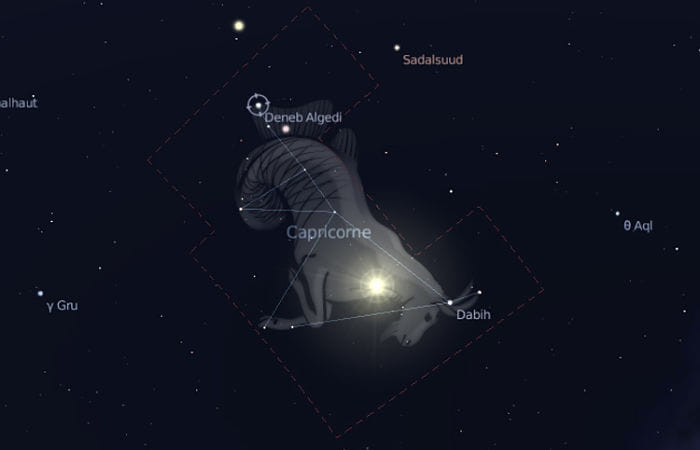
The constellation Capricorn contains eight main stars that make up its shape. Let’s explore them in more detail.
- Deneb Algedi (Delta Capricorni) is the brightest star in the constellation Capricornus (which will be discussed in more detail later).
- Dabih (Beta Capricorni) is the second brightest star in Capricornus; however, it is classified as a star system –
- Dabih Major (Beta-1 Capricorni) and Dabih Minor (Beta-2 Capricorni) – both of which are composed of multiple stars.
- Algiedi (Alpha Capricorni) gets its name from the Arabic al-jady, meaning “male goat.” This optical binary star consists of two star systems: Prima Giedi (Alpha-2 Capricorni) and Secunda Giedi (Alpha-2 Capricorni).
- Nashira (Gamma Capricorni) is located 139 light-years away and is considered a blue-white giant of type A. Its name comes from Arabic, meaning “bearer of good news.”
- The yen (Zeta Capricorni) is a double star with one component that is a bright barium star and the other is a yellow supergiant type G and a white dwarf.
- Dorsum (Theta Capricorni) is derived from the Latin word “the back (of the goat).” It is also a main sequence white dwarf of type A, located 158 light-years away.
- Baten Algiedi (Omega Capricorni) means “the belly of the goat” and is classified as an M-type red giant star. It is located 630 light-years away.
- Psi Capricorni is a white-yellow giant located 47.9 light-years from Earth.
Brightest star
Of all the stars that make up the constellation Capricorn, none shines brighter than Deneb Algedi. Its name derives from Arabic (oanab al-jady), meaning “the tail of the goat.” This four-star system has a white giant, a star that varies in brightness, and two others that are believed to be orbiting its system. It is also 39 light-years away.
Myth of the constellation Capricorn

Although Capricorn ranks second in weakness after Cancer, its history dates back to the 21st century BC. This began with the Sumerians and Babylonians. The Sumerians called it the goat fish (SUHUR-MASH-HA – “goat fish”). In the early Bronze Age, the constellation marked the moment of the winter solstice.
And in modern astrology, it still marks the first day of winter. The Greeks saw in it a forest deity Pan with goat horns and hooves. He also had a son, Crotus, who was referred to the constellation Sagittarius. Pan rescued and saved the gods of Olympus several times, so Zeus thanked him. He distinguished himself during the war with the Titans, when he frightened them by blowing a trumpet made from his horn.
Later, he warned of the approach of the monster Typhon, and also suggested that the gods transform themselves into animals at the most dangerous moments. There is also a myth about why Pan looks so strange. He himself had to flee from the monster, so he wanted to turn into a fish and hide in the Nile. But the transformation was only half complete, after which the monster caught up with him.
Sometimes, in the guise of Capricorn, one can see a goat Almatea, who nursed the baby Zeus when his mother hid him from the witch (his father), who killed all the children. According to prophecy, the child had to overthrow his father, which is what happened in the end.
Celestial objects in the constellation Capricorn
Messier 30 (NGC 7099) is a globular cluster located 28,000 light-years away. It is about 90 light-years in diameter. The cluster is approaching us at a speed of 181.9 km/s. It was one of the first deep-sky objects discovered by Charles Messier in 1764. The spectral type is F3.
It is relatively dense and belongs to the V class of concentrations. The brightest stars are red giants with a magnitude of 12. Like Messier 15, Messier 7, and many other globular clusters in the Milky Way, M30 survived the collapse of its core. It now has a size of only 0.12 arcminutes, and half of the cluster’s mass is within a spherical radius, occupying 17.4 light-years in width. M30 can be seen even in weak telescopes.
Astrology
Capricorn is the tenth sign of the zodiac. People born between December 23 and January 20 are in the sign of the goat. Some characteristics of people born under this sign are:
- Loyal
- Patient
- Ambitious
- Responsive
- Resourceful
Capricorns tend to be a little conceited, distrustful, and unimaginative. They are very independent and rely only on themselves to get the job done right. This sign is best suited to leadership positions and they are always looking to advance in their chosen career.
To an outsider, Capricorns may seem boring, severe, or even melancholic, but this is because they weigh the pros and cons of every decision, making sure it is the right path to take. However, this is an advantage as Capricorns tend to be structured and organized in their lives.

