Discover the Bagua symbol on our website. We show you everything that this mystical symbol, used in many religions and cultures, represents.
What is Bagua?
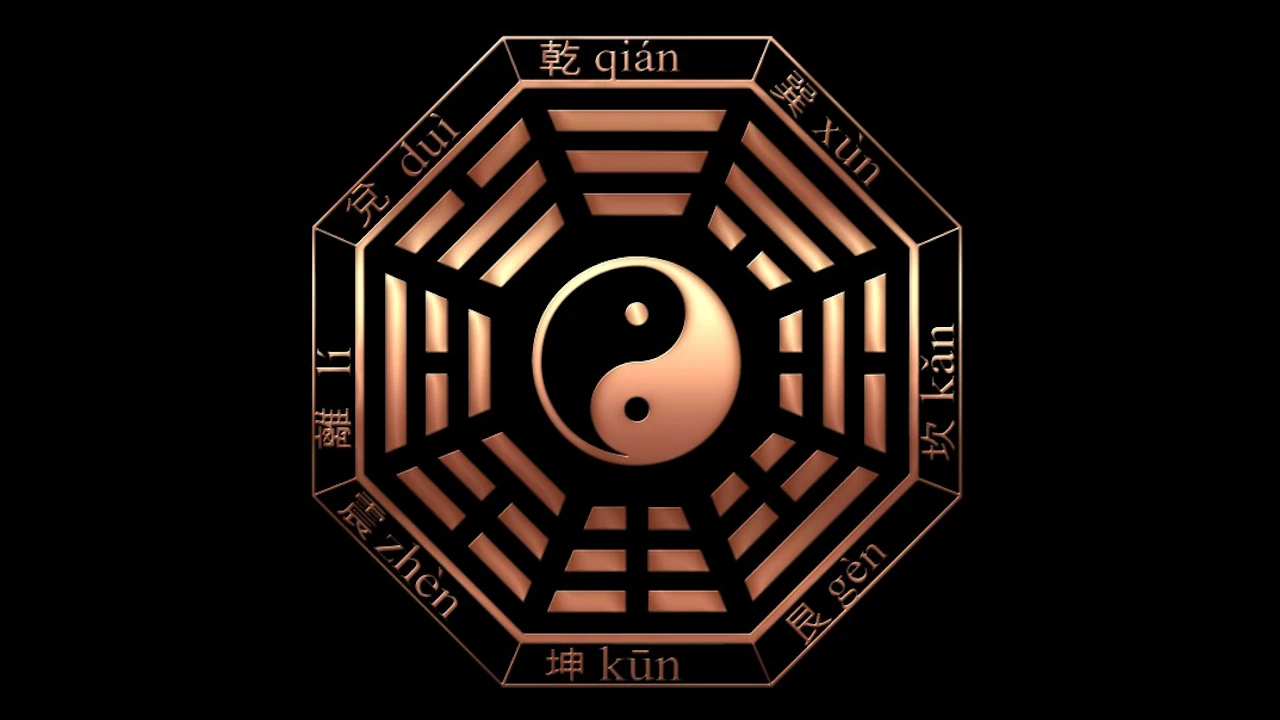
The Bagua or Pa Kua are eight symbols used in Taoist cosmology to represent the fundamental principles of reality, seen as a range of eight interrelated concepts.
Each consists of three lines, each line “broken” or “continuous,” representing yin or yang, respectively. Because of their tripartite structure, they are often referred to asthe “Eight Trigrams”in English.
The trigrams are related to the philosophy of Taiji, Taijiquan, and Wu Xing, or “five elements.” The relationships between the trigrams are represented in two arrangements, the primordial, “The Earlier Heaven” or “Fu Xi” bagua, and the Manifest, “The Later Heaven,” or “King Wen” bagua.
The trigrams have correspondences in astronomy, astrology, geography, geomancy, anatomy, the family, and other areas. The ancient Chinese classic consists of the 64 permutations of pairs of trigrams, called “hexagrams,” along with commentary on each.
1. Bagua used in Feng Shui
The Bagua is an essential tool in most schools of Feng Shui. The Bagua used in Feng Shui can appear in two different versions:
The Bagua of the Former Heaven, used for burial sites, and the Bagua of the Later Heaven, used for residences.
Xiantian Bagua
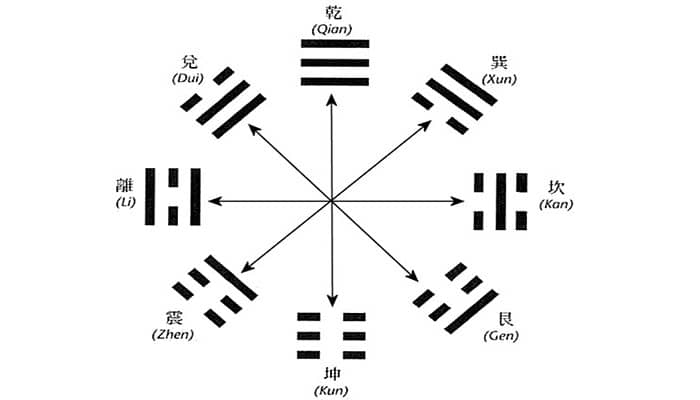
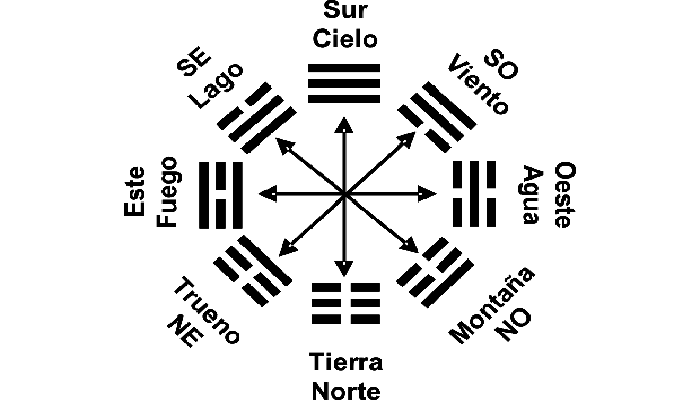
In Xiantian Bagua, also known as Fu Xi Bagua, Heaven is at the top and Earth is at the bottom.
The trigram Qian (Heaven) is at the top, the trigram Kun (Earth) is at the bottom. The trigram Li (Fire) is on the left and opposite it is the trigram Kan (Water). Zhen (Thunder) and Xun (Wind) form another pair, while they are opposite each other, the first on the lower left next to Li, while the second is next to Qian on the upper right of the Bagua.
Gen (Mountain) and Dui (Lake) form the last pair, facing each other, both in balance and harmony.
The arrangement of the trigrams is symmetrical, forming exactly opposite pairs. They symbolize the opposing forces of Yin and Yang and represent an ideal state, when everything is in balance.
Houtian Bagua
The sequence of trigrams in Houtian Bagua, also known as King Wen’s Bagua, describes the patterns of environmental changes. Kan is placed at the bottom and Li at the top, Zhen in the east and Dui in the west.
Contrary to the principles of Heaven Bagua, this is a dynamic Bagua where the energies and aspects of each trigram flow into the next. It is the sequence used by the Luo Pan compass used in Feng Shui to analyze the movement of Qi that affects us.

2. Western Bagua
Feng shui became very popular in the West thanks to the Bagua of the eight aspirations. Each trigram corresponds to an aspect of life, which in turn corresponds to one of the cardinal directions. The application of Feng Shui using the Bagua of the eight aspirations (or the Bagua map for short) made it possible to simplify Feng Shui and make it accessible to everyone. Western Bagua focuses more on the power of intention than traditional forms of Feng Shui.
Traditional feng shui masters ignore this approach because of its simplicity, as it does not take into account the forms of the landscape or temporal influences or annual cycles. The Eight Aspirations Bagua is divided into two branches: the first uses a compass and cardinal directions, and the second uses the Bagua based on the front door. Clearly, without taking cardinal directions into account, the second branch is even simpler.
3. Bagua Map
A Bagua map is a tool used in Western forms of feng shui to map a room or location and see how different sections correspond to different aspects of life. These sections are believed to relate to each area or aspect of life and are divided into categories such as: fame, relationships/marriage, children/creativity, helpful people/travel, career, inner knowledge, family/ancestors/health, and wealth/blessings.
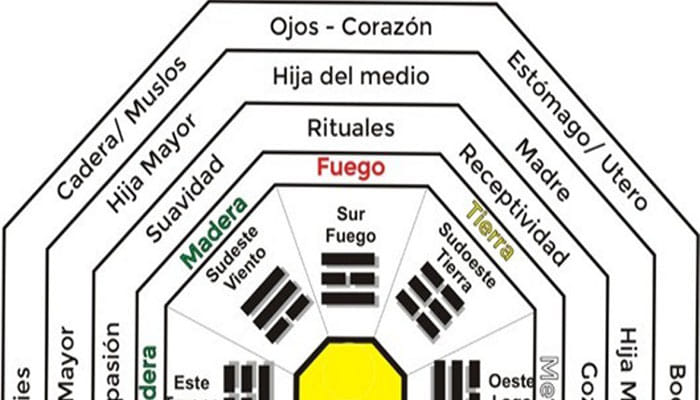
In this system, the map is designed to be used over the land, house, office, or desk to find areas that lack good chi and to show where there are negative or missing spaces that may need rectification or improvement in life or the environment.
For example, if the Bagua grid is placed over the floor plan of the entire house and shows the toilet, bathroom, laundry room, or kitchen in the wealth/blessings area, it would be considered that money entering that particular environment would disappear very quickly, as if it were “going down the drain.”
4. Bagua Symbol
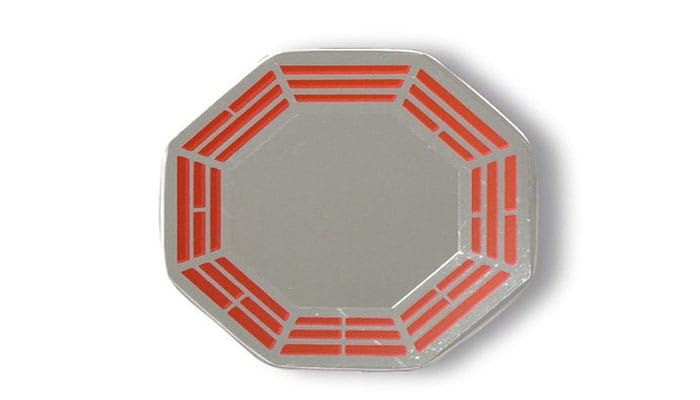
An important Chinese symbol, the Bagua (also called Pa Kua) is an 8-sided shape made up of 8 trigrams. It has the taiji or yin and yang symbol in the center and the eight trigrams are arranged around it to complete the octagonal figure.
Bagua symbols represent the ever-changing forces and natural phenomena of the universe as described in the I Ching. Each trigram features long (yang) and short (yin) lines or a combination to represent the eight compass directions.
‘Ba’ means eight and ‘gua’ means areas or sections; collectively Bagua refers to a group of eight symbols that have a specific meaning in Chinese philosophy. The eight symbols or trigrams are formed by a combination of three lines that are unbroken or broken.
The continuous line represents the masculine ‘yang’, the creative force of nature, while the broken line denotes the feminine ‘yin’, which is the receptive force of nature. These trigrams symbolize the interrelated natural processes and basic principles of reality. Each of these is associated with a particular family member, season, direction, personality trait, animal, etc.
5. The meaning of Bagua
A Bagua map, also known as pa kua, is a feng shui tool that locates areas of positive and negative energy in a home or office. Once the areas are identified, applying feng shui cures where necessary allows positive energy, known as chi, to flow freely throughout the space.
Bagua diagrams and how to use them
Shaped like an octagon, the bagua consists of nine areas. Each of the eight sides of the bagua diagram and the central circle correlate to a specific aspect of life.
6. Chinese Bagua symbols
The symbols of the Bagua are a yin yang and eight trigrams.
Yin Yang Center
The center of the bagua, a yin yang, symbolizes the balance found within the earth and your life. In bagua, the earth represents your home or office. Each of the other eight areas directly affects the central area, just as each aspect of life directly affects you.

Trigrams
In each of the eight sections of the bagua there is a trigram. Each trigram is a series of three lines, called Chinese Yao symbols. The lines are in various combinations and symbolize the following:
-
- Sky: Quian or Chien
- Earth: Kun
- Fire: Li
- Water: Kan
- Lake: Dui
- Wind: Xun
- Thunder: Zhen
- Mountains: Gen

7. The meaning of the trigrams
The lines of the trigram are a long solid line or two short lines. The continuous line represents the yang or masculine energies of nature, while the yin, the feminine energies, are represented by two short dashes. The Yao lines are joined in three groups, one above the other.
Heaven
The trigram symbol for heaven is three continuous lines, showing the masculine energy that is strong and undivided. Heaven is classified as the father. The translation for heaven is Quian, Chien, or Chyan. Heaven is the creative celestial force from which everything occurs. Its direction is northwest, and it represents helpful people and travels on the Bagua map.
Earth
The translation for Earth is Kun. Its trigram is three yin lines, as it is receptive and open to natural forces such as the sun and rain. Earth is the complement of heaven and represents the feminine as mother earth and the origin of life. On the Bagua map, the direction of Earth is southwest, which represents love and marriage.
Thunder
The trigram for thunder consists of one continuous line below two broken lines. Representing a strong movement, thunder is full of vitality and activity as it develops and grows. The translation for thunder is chen. The Bagua direction for thunder is east, representing health and family on the Bagua map.
Water
Translated as kan, the trigram for water is a solid line above and below a broken line. Water represents challenges, mystery, and deep meaning. The trigram for water is the opposite of the trigram for fire; only water and fire are opposites. The direction of water on the Bagua map is north, representing the professional aspect of life.
Mountain
The translation for mountain is ken or gen, and its symbol in the bagua is two continuous lines above a broken line. The direction of the bagua is northeast, representing the aspect of life related to knowledge and cultivation.
Wind
The trigram for wind is a broken line below two continuous lines. It represents the vital aspect of wealth and prosperity, and its direction is southwest. The translation for wind is xun.
Fire
Translated as li, the direction of fire on the Bagua map is south. It represents the vital aspect of fame and reputation, which is often referred to as the area of illumination. The trigram for fire is a broken line between two solid lines.
Lake
The trigram for lake is two solid lines below a broken line, showing that a lake is receptive and open at the top and solid at the bottom. It represents happiness and joy. The bagua direction of the lake is west. It represents the aspect of life related to creativity and children. The translation for lake is tui or dui.
8. Additional resources
Each trigram has an opposite pole in the bagua octagon. It is designed to maintain the proper balance of yin and yang energy. In the Black Sect Tantric Buddhist School of Feng Shui, the bagua map is used in the same way for every application with the south sector placed at the top of the house layout.
In classical feng shui, it is placed according to the compass directions, allowing for an authentic grid view of your home and the governing energies based on these compass points. The trigrams of a bagua help determine whether the chi energy in a home or office is positive (yang) or negative (yin) and whether a remedy or cure is required.

