Aten is the sun disk and was worshipped from the third dynasty as an aspect of Ra in Egyptian mythology. The worship of a deified form of Aten became a state religion during the reign of Amenhotep IV, who later changed his name to Akhenaten (meaning effective for Aten).

Origin
He is first mentioned as a deity in the twelfth dynasty literary work, The Story of Sinuhe, and is also mentioned in the ancient Egyptian Book of the Dead. The Hymn to Aten, attributed to Akhenaten, contains an additional reference to the deity in the form of poetic veneration found inscribed in various versions in the tombs of courtiers.
Appearance
The symbol of the sun disk appeared as a sun disk with rays eman ating from the disk and ending in human hands, along with the ankh. Unlike other gods and goddesses, he was never depicted in human form, and his name appeared in cartouches alongside the titles generally attributed to a pharaoh.
The rise of Aten
During the reign of Akhenaten, from 1353 to 1336 BC, Egypt underwent major religious and cultural changes, many of which were not well received by the people. The worship of many gods and goddesses had been an intrinsic part of Egyptian religion for thousands of years, yet even with this long history of polytheism, Akhenaten turned the tables and forced monotheism upon the people.
At the beginning of his reign, he and his wife, Nefertiti, worshipped many gods and goddesses, particularly Amun. At this time, the capital was located in Thebes, which also housed the great temple of Amun. The priests of Amun gained great wealth and power during this period, possibly even more than the Pharaoh himself.
Perhaps after observing the sun and its life-giving powers, Akhenaten interpreted Aten, an even lesser-known deity on the solar disk, as omnipresent and the primary life-giving force of the universe. He came to believe that Aten was the only god and began to worship only him.
Events that took place

In order to establish themselves and their new religion with greater prominence, Akhenaten and Nefertiti moved from opulent Thebes and its great temple of Amun to a new capital, Akhetaten. Although the people were unwilling to abandon polytheism in favor of a single god, worship of the sun disk now replaced worship of Amun and other deities.
New temples were built to worship Aten, and Amenhotep IV, as he was then known, changed his name to Akhenaten. He then began to associate himself closely with the image of Aten, portraying himself as the mother and father of Egypt. He saw himself as a living god and the sole representative of the sun disk on Earth.
Apart from his wife, he gave her more power than the priests! Under his religious rule, which bordered on tyranny, it was also declared that the rays of light from the sun disk shone only on the royal family. Everyone else could only receive life through him and Nefertiti, if they were loyal to him.
The Pharaoh’s obsession with building the cult of Aten left Egypt militarily weak to the point where the land was taken over by the Hittites. This did little to win the support of his people, who were already aggrieved by the fact that all the power and wealth of Egypt was directed toward this singular deity.
Temples and Priests of Aten
The temples of Aten were open-roofed and colorful, in contrast to earlier temples, allowing light to flood into the building. The temples did not house statues of the deity as this was considered idolatry, but they did have representations of the Pharaoh and his family worshipping Aten.
Priests were expected to worship Akhenaten and Nefertiti as gods on earth, and although there were no processions in the name of Aten, the people had the opportunity to pay homage to the royal family when they traveled in their chariot on holidays.
Not only were the temples of other gods destroyed in the name of Aten, but the Pharaoh even erased the cartouche of his own father where it appeared in the temples, as it contained the name of Amun.
A revolution in art
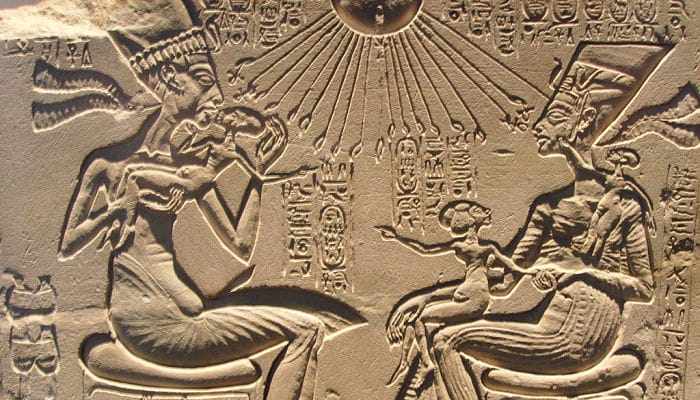
On steles and statues, which normally only depicted the king, the tradition changed and the royal couple was depicted instead. Nefertiti is even depicted slaughtering Egypt’s enemies, an image that used to be strictly reserved to symbolize the king. Akhenaten also influenced art in the changes in the way images were drawn:
From a formal and rigid style to one in which people were drawn with thin limbs and cone-shaped heads. Even intimate moments of the royal family were depicted, a good example being an image of Akhenaten and Nefertiti in a chariot kissing under the rays of Aten.
The decline of Aten
With the death of Akhenaten in 1336 BC, the cult of Aten also died. His city, Akhetaten, was destroyed and the people returned to worshipping the many gods and goddesses they had before his rule. Akhenaten became known as the Heretic Pharaoh. People even avoided using his name, referring to him instead as the Heretic or Rebel. Cartouches bearing his name were scraped off, and his name and that of his successor were left off the official list of Egyptian pharaohs.
Whether in ancient or modern times, people have always hated change. When radical change is imposed in a tyrannical manner, it is not surprising that feelings of dissonance arise. Aten may have shone upon the royal family during Akhenaten’s reign, but the Heretic Pharaoh and his deified sun disk quickly became a dark memory for his people.