Atlantis, a mysterious and vanished world. Throughout countless generations, cultures have idealized the lost civilization of Atlantis, the lost world of leaders and great minds that was brought to its knees by its own greed. It has served both as a cautionary tale and a source of wonder and amazement for the intellectually curious.
How did the land that was Atlantis come to be? And what can be gleaned from the history of a race that was once proud and powerful before being brought low by the gods of ancient Greece?
What was Atlantis?
According to legend, the ancient gods and goddesses divided all the land in the world among themselves. Poseidon was given the island of Atlantis—which was actually the size of a continent. Atlantis was said to be larger than Libya and Asia Minor combined, making it a respectable piece of land to inherit. Poseidon was happy with his assigned land. He fell in love with a woman who lived on the island named Cleito. They were married and had five sets of twins together, all sons.
Did Atlantis exist?
The eldest son, Atlas, was given power over the entire island, which was also named in his honor. In addition to being king of the island, he was also named king of the sea. This is how the Atlantic Ocean got its name. Although he technically had control over the entire island, he decided to make the mountain where he was born and the surrounding land his home.
Atlas’ twin, Gaderius, also received a considerable inheritance. He is said to have been given control over the area of Atlantis that was closest to “the Pillars of Hercules.” The other four pairs of twins were also very prosperous. All of them were known for having impressive lands and many subjects. Their names were Ampheres, Evaemon, Mneseus, Autochthon, Elasippus, Mestor, Azaes, and Diaprepes.
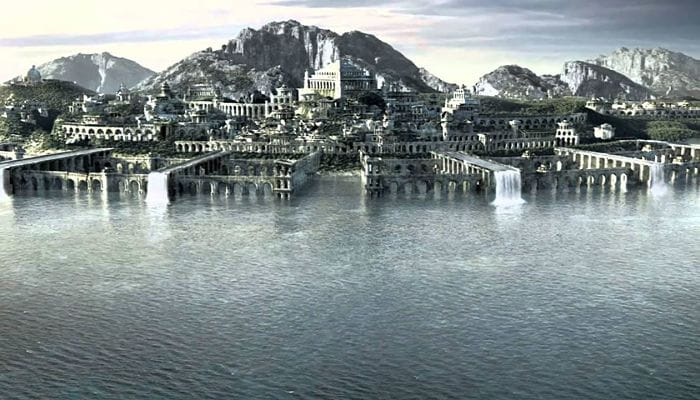
In addition to securing great wealth for his children, Poseidon also built a great city for his love, Cleito. He carved the mountain where she lived into a great palace and placed three moats around it, each larger than the last. The moats were approximately one to three stadia wide and were separated by rings of land that were also expansive.
Bridges were built leading to the island, and tunnels were dug in the moats to allow ships to pass in and out of the main city. Each moat was heavily guarded to ensure the protection of Cleito and her children. The island was also rich in resources. No one had to work hard to survive; all work was relatively easy and done to a high standard of living.
Every food grew on their land, and animals were plentiful enough for everyone who lived there. The land was also rich in precious metals such as gold and silver. In addition, Poseidon himself had created a stream of hot water and a stream of cold water that ran through the island to ensure that all the people’s needs were met.
What happened in the Land of Paradise?
It seemed that the future of Atlantis was incredibly bright and prosperous. However, as the years passed, problems began to arise. Atlantis remained the culturally rich and immensely wealthy island country it had started out as, but greed began to creep into the hearts of the people.
It is often said that this greed came about when the gods began to marry humans living on the island. It is possible that the sudden exposure to the increased wealth and power granted to these humans made them hungry for more than they needed. This greed caused them to look beyond their own country and seek to conquer other lands.
They began with the area within the ‘Pillars of Hercules’ and sought to control all the land in the Mediterranean. Country after country began to fall to the power of the Atlanteans until only one power stood against them: ancient Athens. By some miracle, Athens was able to defeat the superior Atlanteans, and the conquerors of Atlantis were forced to return home defeated. However, this is not the end of the story.
Zeus had been angered by the actions of the Atlanteans and their attempts to conquer lands far beyond their own. Because of this, he sent a series of earthquakes so great that Atlantis sank into the sea in the course of a day and a night.
Was Atlantis an allegory or a reality?
The legend of Atlantis has been one of the most intriguing and inspiring tales that continues to captivate modern society. This is truly fascinating considering that ‘Atlantis’ itself had no meaning in Plato’s body of work. There are many questions that continue to spark great interest in the case of Atlantis. Perhaps the most intriguing is whether the story has any historical accuracy.
There are many different perspectives when it comes to arguing the case for Atlantis. Although most (but not all) people believe that Atlantis is a tale that has been wildly embellished, it is unclear what percentage of the story is fiction. Was Atlantis really inspired by a world that was stolen by the ocean?
Is it conceivable to think that such an advanced civilization could disappear so suddenly without leaving any trace of its culture? And if Atlantis was simply an allegory used to convey a message, what information can be gleaned from the story? To fully understand the confusion that comes with the story of Atlantis, it is necessary to examine the texts and the different authors who have written about it.
Plato and Atlantis
Plato is well known for his many philosophical works such as ‘The Republic’, but interestingly, the story of Atlantis was not meant to be one of his most prominent works. The story is embedded in ‘Critias’ and ‘Timaeus’. Apart from these two pieces, no reference to Atlantis can be found in his writing. Interestingly, however, there is at least one work known to have referenced Atlantis before Plato recorded the story in ‘Critias’.
Plato supposedly quotes Solon, who supposedly traveled to Egypt between 590 BC and 580 BC. While there, he supposedly came across Egyptian records of Atlantis and translated them. It was through these records that he discovered the story of Atlantis. This story was supposedly passed down by Solon and eventually Critias became aware of the legend. It is the character of Critias who narrates the story of Atlantis in Plato’s dialogues.
Critias explains that 9,000 years before the story he recountswas told, Atlantis went to war with neighboring countries to expand its territory and show its power and superiority. Alliances were made, but one by one all the powers fell until only one remained: ancient Athens.
Coincidentally, the ancient Athens described in this story has a suspicious number of similarities to the ideal society described by Plato in “The Republic.” Because of this, many people wonder if Plato could have invented the story of Atlantis to use it to prove that his idea of a perfect society was correct.
Contradictory Theories
In Plato’s time, it was widely accepted that Atlantis was an allegorical work used to express Plato’s vision of an ideal society. There were many works that were thought to be inspired by Plato’s use of allegories—especially by Renaissance writers. Some works believed to be inspired by his methods include Francis Bacon’s “New Atlantis” and Thomas More’s“Utopia.” These works followed a similar allegorical model and used this structure to prove their point.
However, in the 19th century, more and more people began to associate Atlantis with a real place that had been lost or destroyed. Although they did not believe the entirety of Plato’s story, they believed that the story of Atlantis had some truth to it: the only question was what had been exaggerated or fabricated, and what could be used as clues to discover Atlantis’ identity.
Many different ideas were proposed to solve this mystery. Some people suggested that the story might have originated from the lost island of Thera. Others believed that the submergence of the world could indicate that Atlantis was lost in the “Great Flood” that was thought to have covered the Earth for 40 days and 40 nights, according to Christian texts. This latter theory gained a lot of popularity due to the fact that the story of Atlantis, as told by Plato, makes it very clear that the island was lost in the course of a day and a night.
Atlantis and Hellanicus of Lesbos
Many who believe that Plato was describing a real place often point to the writings of Hellanicus of Lesbos. Hellanicus also wrote a work entitled ‘Atlantis’. It is believed that Hellanicus’ work was one of Plato’s main inspirations when he was putting together his own story of Atlantis. Unfortunately, only fragments of Hellanicus’ ‘Atlantis’ survive.
The remaining pieces seem to indicate that Hellanicus’ work described the genealogy of the family of Atlas, specifically his daughters. Although Hellanicus’ only surviving work, ‘Atlantis’, seems to be linked to genealogy, there are many who still believe that Plato adopted Hellanicus’ ideas to suit his work because of the way he writes about the genealogy of Atlantis. Plato’s writing style is almost identical to Hellanicus’s in this regard, making it very plausible that he was inspired by reading his work.
Atlantis as perceived by religion
Interestingly, religion also takes a position on the myth of Atlantis. In fact, it seems that some religions believe that Atlantis may have been real and often alluded to in their religious texts. An example of this can be found with Clement of Rome, who apparently tried to refer to Atlantis in his Epistle of Clement, 20:8: “…The ocean that is impassable to men, and the worlds beyond it, are governed by the same ordinances of the Master.”
Many people think that Clement was referring to the lost land of Atlantis because of the way he describes this distant place. This hypothesis has credibility, especially when you consider that the myths surrounding Atlantis describe it as the creation of an area of calm sea when it sank to the bottom of the ocean.
In addition, a text on astronomy written in Hebrew and believed to have been written around 1378 or 1379 AD focuses on zero points and the calculation of longitude, but refers to scholars who lived on an island in the middle of the ocean.
These scholars were known to isolate themselves from the rest of the world in order to continue their quest for knowledge, and they were believed to be the first people to attempt to measure the world in terms of longitude and latitude. Unfortunately, however, the island that was once inhabited by the scholars had been lost in the ocean—and their knowledge along with it.
Possible Locations of Atlantis
As more and more potential references continue to come to light regarding Atlantis, there continue to be different proposed locations for Atlantis that come to light. While nothing has been concrete enough to prove it, there have been many theorists who have attempted to prove that their country, race, island, etc., are descendants of the Atlanteans.
These claims are made for a variety of reasons—some base their theories on the geographical context provided in Plato’s texts and other ancient writings. Others believe that the advanced nature of their race is evidenced by their connection to the ancient Atlanteans.
The Eruption of Thera
The eruption of Thera (a massive volcano) had a huge impact on the ancient world. Thera erupted with a force that man has never witnessed before or since. It is said to have had the power of several hundred atomic bombs exploding at the same time! There were massive effects around the world, possibly as far away as China and North America, and it is estimated that the explosion itself could be heard over 3,000 miles in any direction.
Thera took over a large part of the island of Santorini and had a dramatic effect on the climate and history as it was known at the time. A peaceful civilization known as the Minoans had lived on the island. They were known for their efficient bureaucracy and advanced civilization.
The Thera explosion, however, gave way to the belligerent city-states of ancient Greece to take control in terms of power. The lack of possessions and bones on the island suggests that most of the Minoans were able to evacuate the island before the explosion occurred. Despite this, their position in ancient society was destroyed, probably due to the events that followed the explosion.
It is believed that more than 40,000 people died in just a few hours and that tsunami waves at least 40 feet high were generated. Volcanic ash spread as far as Asia, and temperatures are known to have dropped considerably. There were also strange sunsets for at least three years after the event. These events would have destroyed the coastal cities of the Minoans and prevented them from having good harvests the following year, effectively ruining them.
The large-scale impact of this event often leads others to conclude that Atlantis must have been the partially sunken island of Santorini. In fact, the eruption of Thera was so influential that it is also believed to have been the cause of many of the biblical references to the Great Plagues that struck Egypt.
The Sea Peoples
Due to the warlike nature of the Atlanteans described before the fall of their civilization, there are many hypotheses connecting them to ‘The Sea Peoples’. Although the official identity of the Sea Peoples remains a mystery, it seems clear that they were known to pose a great threat to Mediterranean civilizations, similar to the way the Atlanteans were thought to have caused problems.
Ancient records seem to indicate that the Sea Peoples attempted to invade Anatolia, Syria, Phoenicia, Canaan, Cyprus, and Egypt at the end of the Bronze Age. Although the Sea Peoples have been a recorded threat to many different civilizations, they have not been officially connected to any culture or race, making it difficult to claim that they actually originated in Atlantis.
The Gulf of Laconia
The Gulf of Laconia is often pointed to as a likely location for the settlement of Atlantis due to its close relationship with an ancient geographical location—the Pillars of Hercules. The two lands pointing south on either side of the Gulf of Laconia were considered to be the Pillars, which made this region in general popular for speculation about the location of Atlantis.
People who investigate this theory typically claim that Atlantis could have been located near Capes Matapan or Maleas. However, these opinions are somewhat controversial when you consider that the Atlanteans would have had to attack from the south if they had come from these islands, and not from the west, as the stories clearly state.
The Mayan Connection
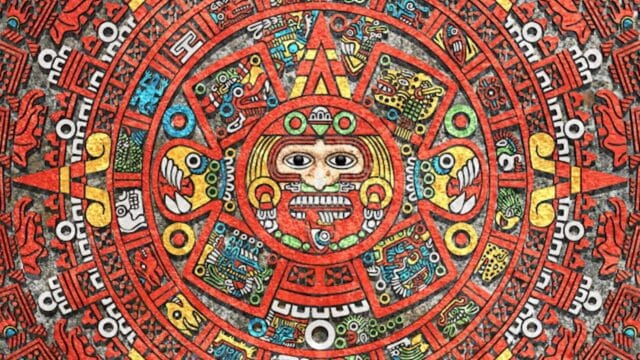
When Europeans first encountered the Americas, they were instantly fascinated by the indigenous tribes, especially the Maya and their ruins. There are, however, some Atlantis theories that have emerged from observations of Maya ruins and the geography of South America.
One of the first theories that the land inhabited by the Maya could be linked to the lost civilization of Atlantis probably came from Abraham Ortelius, a cartographer and geographer. Ortelius is the first person to have conceived the idea that the continents were once joined before they separated, causing them to drift to their current positions.
This theory led him to create another theory about the land of Atlantis. He wrote about it in the 1596 edition of ‘Thesaurus Geographicus’, saying: “Unless it is a fable, the island of Gadir or Gades will be the remaining part of the island of Atlantis or America, which did not sink, but was torn away from Europe and Africa by earthquakes and floods….”
This is probably one of the biggest influences on Mayanism, leading people to connect the Mayans with the ancient civilization of Atlantis. However, there were many problems with this line of thinking—most of them resulting in the racism with which the idea was explored. Europeans did not believe that the natives of the Americas were intelligent enough to build the ruins they had as possible candidates for the civilization of Atlantis. They saw the natives as inferior races and would have considered it an insult to entertain the idea that they had anything to do with the magnificent ruins that had existed before them.
Instead, they believed that the Maya were a separate race that had somehow disappeared and been lost to history. There were also those who speculated that Aztec culture might also have connections to Atlantis. Eventually, the theory that Maya and Aztec cultures were connected to the ancient Atlanteans was proposed earlier by Mesoamerican scholars.
One of the most knowledgeable scholars of his time—Brasseur de Bourbourg—was known for having traveled extensively throughout South America in search of the connection between the Maya and the Atlanteans. He was known for his numerous translations of ancient texts such as the Popol Vuh (an ancient Mayan sacred book) and was known for having gathered a wealth of information about the history of the region.
Unfortunately, however, his credibility in the academic community was undermined when he claimed that the Maya were descended from the Toltecs—a surviving race that he theorized had descended from the “racially superior” civilization of Atlantis. This was likely due to the widespread racism that surrounded research on Maya culture.
Despite being discredited, there were those who were inspired to excavate Mayan ruins as a result of Brasseur de Bourbourg’s work. Although there was no concrete evidence, some of those who investigated thought they had found connections between Greek and the Mayan language, leading to further speculation about connections with the lost continent.