Athena was an intriguing goddess in the myths of the goddess Athena. Famous for her wisdom and courage, she became the favorite daughter of the god Zeus. According to the myths of Athena, as her name suggests, she was closely related to the capital of Greece. For a long time, it was unknown whether Athena was named after Athens or Athens was named after Athena.
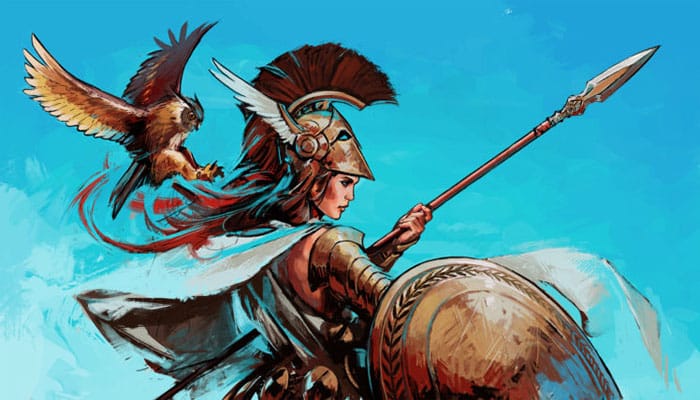
The myths of Athena are an important part of Greek mythology. She is considered the goddess of wisdom, to whom values such as justice and reason are attributed. She was supposedly the favorite daughter of the deity Zeus, the object of his affair with Titan Metis. Needless to say, she was considered one of the most powerful Olympian deities. She was worshipped by many who would take her as their protector. One city had a particular love for her, and is named after her, Athens.
Athena was a powerful and popular goddess in ancient Greece. Athena had no mother. She was born directly from the brain of Zeus, and that is how she received her remarkable intelligence. She is sometimes also considered the goddess of war because Athena had the power to give skill, courage, and victory in battle to those who deserved it.
Athena held a seat on Mount Olympus, in the council of twelve, the rulers of the gods. The other gods counted on Athena to be fair. Zeus admired Athena for her wisdom, kindness, and understanding. Even her grumpy uncle, Poseidon, had a special place in his heart for his niece, Athena, the goddess of wisdom.
Here are some myths about Athena that show how intelligent, thoughtful, and practical she was in the myths of the goddess Athena.
1. Athena born from the head of Zeus
The myths surrounding the conception and birth of Athena are quite strange. Even before Zeus learned that Metis was pregnant, he was concerned about the prophecy that the children of this union would become more powerful than Zeus himself.
According to the myths of Athena, given the implications of this, he set out to prevent this from happening and swallowed Metis. However, as she was already pregnant, she gave birth to Athena inside Zeus’ body. Athena was thus born from Zeus. From his head.
As Athena grew up, she disliked fighting and conflict. However, she possessed great skill and military leadership, and quickly became associated with saving others from wars by lighting the way for heroes.
The myths of the goddess Athena are often mentioned in the stories of other Greek characters such as Perseus, Heracles, and Odysseus. According to legend, she was the one who helped Perseus kill Medusa; she ordered Heracles to kill the Nemean Lion with his own claws, and she also guided him to subdue the Stymphalian birds.
2. Myths of Athena: The Magic Rocks
According to the myths of Athens, which mentioned Ares, the Greek god of war, he did not care who won or lost a battle. He simply enjoyed war.
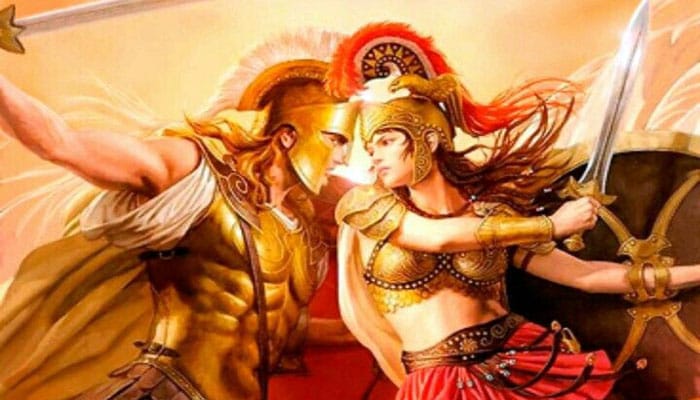
Act I: The Battle Between Ares and Athena
Once upon a time, long ago, the Greek god of war, Ares, was fighting against the Greeks in a field at the northernmost tip of ancient Greece.
The field was on the border of Macedonia, a country to the north. The Macedonians always crossed the line, trying to conquer the Greek city-states one at a time. Ares watched that field closely, as many battles had been fought there.
Ares didn’t want to miss a good battle. Athena, goddess of wisdom, saw her half-brother shouting and screaming happily as the Greeks died around him. Athena believed that the Greeks’ cause was just, as they were simply defending their home. She picked up a rock and threw it as hard as she could at Ares.
Ares wasn’t paying attention, as usual. He was busy reveling in the bloodshed. The rock knocked him unconscious. When he woke up, the battle was over. The Greeks had won! Ares never knew that it was his sister, Athena, who had knocked him out of the battle!
Act II: The Magic Rock
After that, no one knows how, but somehow, a rumor began that the great god Ares had been attacked by a magic rock! No one heard the rumor, no one but two young brothers. The brothers owned the field where the battles continued.
It was very difficult to farm while the men were fighting. The boys had become giants! Well, not giants perhaps, but certainly tall, manly, and strong. The boys quietly gathered a huge pile of heavy rocks, hoping that one of them would be a magic rock. Their neighbors thought they were building a wall to help protect their field from the Macedonians.
Act III: The Arrival of Ares
According to Athena’s myths, they were actually waiting for Ares. They knew that Ares would show up sooner or later, because Ares loved bloodshed, and he had fought many battles in their field. Ares was bound to keep checking.
Sure enough, one day they saw the great god Ares in their field. They threw stones at him. They were very lucky that one of their rocks hit Ares and knocked him unconscious before Ares realized what they were doing. The boys quickly put Ares in a huge vase and plugged the lid securely.
Ares was trapped in that jar for a long time. And for a long time, the brothers lived a peaceful life. No battles were fought in their field. Their crops flourished. Their northern neighbors became their friends. Ares might still be in that jar today if one of the brothers hadn’t boasted to a neighbor about what they had done. Sooner or later, the rumor reached Hermes’ ears.
So Hermes rescued his brother, not that Ares said thank you. But Ares never returned to that field, thinking perhaps that the story of the magic rocks was true! And the brothers were able to live in peace.
3. Myths of Athena: Arachne, the spider woman
This is one of the myths of Athena that has a cruel ending. There was a contest in which a mortal dared to compete with Athena. That mortal was Arachne, a maiden who had become so skilled in the arts of weaving and embroidery that even the nymphs would leave their groves and fountains to come and admire her work. Not only was it beautiful when it was done, but it was also beautiful while it was being done.
Act I: The arrogance of Arachne
This myth of the goddess Athena says that as she took the wool in its rough state and formed it into rolls, she separated it with her fingers and carded it until it looked as light and soft as a cloud. She spun it with skillful touch, and after weaving it, she adorned it with her needle. The myths of Athena say that there was a rumor that Athena herself had taught her.
But she denied this, and could not bear to be considered a disciple, even of a goddess. “Let Athena prove her skill against mine,” she said; “if I strike her, I will pay the penalty.” Athena heard this and was displeased. She took the form of an old woman and went to give Arachne some friendly advice.
“I have had much experience,“she said, “and I hope you will not disregard my advice. Challenge your fellow mortals as you wish, but do not compete with a goddess. On the contrary, I advise you to ask her forgiveness for what you have said, and as she is merciful, she may forgive you.”
Arachne stopped spinning and looked at the old woman with anger on her face. Keep your advice, she said, “for your daughters or servants; as for me, I know what I say, and I stand firm. I am not afraid of the goddess; let her prove her skill, if she dares to venture forth.” “She comes,” said Athena, and removing her disguise, she confessed. The nymphs bowed in homage, and all the spectators paid their respects.
Act II: The contest begins
Only Arachne was not terrified. She blushed, indeed; a sudden color stained her cheek, and then she turned pale. But she remained firm in her resolve, and with a foolish presumption of her own skill she rushed upon her fate.
Athena no longer forbade or interposed any further advice. They proceed to the contest. Each takes her station and connects the web to the beam. Then the slender shuttle passes back and forth between the threads. The reed with its fine teeth strikes the weft into place and compacts the web.
Both work quickly; their skilled hands move swiftly, and the excitement of the competition makes the work light. The dyed wool from Tyre contrasts with that of other colors, shaded so skillfully that the union deceives the eye. Like the rainbow, whose long arc colors the heavens, formed by the sun’s rays reflected in the shower, where the colors meet, they appear to be one, but a short distance from the point of contact they are completely different.
The myths of Athena say that her loom was represented by the twelve heavenly powers, Zeus, with an august gravity, seated in the middle. Poseidon, the ruler of the sea, holds his trident, and seems to have just struck the earth from which a horse has leaped. Athena represented herself with her head covered by a helmet, with the aegis covering her chest.
Such was the central circle; and in the four corners were depicted incidents illustrating the displeasure of the gods toward the presumptuous mortals who had dared to challenge them. These were warnings to her rival to abandon the contest before it was too late.
Act III: Arachne wins the contest
Arachne filled her loom with designs intended to show the faults and errors of the gods. One scene depicted Leda caressing the swan, under which Zeus had disguised himself; and another, Danae in the bronze tower where her father had imprisoned her, but where the god made his entrance in the form of golden rain.
Another scene depicted Europa being deceived by Zeus in the guise of a bull. Encouraged by the animal’s gentleness, Europa ventured to ride on its back, whereupon Zeus plunged into the sea and swam with her to Crete. She would have thought it was a real bull, so naturally she forged herself, and just as naturally the water in which she swam.
She seemed to look longingly toward the shore she was leaving, and to call for help from her companions. She seemed to shudder with terror at the sight of the waves, and to turn her feelings away from the water.
Act IV: The Punishment of Arachne
Arachne filled her canvas with similar subjects, wonderfully well done, but strongly marking her presumption and impiety. Athena could not help but admire them, but she was outraged by the insult. She struck the loom with her shuttle and broke it into pieces; then she touched Arachne’s forehead and made her feel her guilt and shame.
She could not bear it and went to hang herself. Athena took pity on her when she saw her hanging from a rope. “Live,” she said, “guilty woman! And may you preserve the memory of this lesson, continue hanging, both you and your descendants, for all time to come.”
She sprinkled her with the juices of aconite, and immediately her hair fell out, and her nose and ears fell off. In the same way, her figure shrank, and her head became even smaller; her fingers stuck to her sides and served as legs. All that remains of her is her body, from which she spins her thread, often hanging suspended from it, in the same attitude as when Athena touched her and transformed her into a spider.
4. Medusa
In the myths of Athena, it is said that Medusa was once a beautiful and renowned priestess of Athena who was cursed for breaking her vow of celibacy. She is not considered a goddess or Olympian, but some variations of her legend say that she joined one.
When Medusa had an affair with the sea god Poseidon, Athena punished her. She turned Medusa into a hideous half-snake woman, transforming her hair into writhing snakes and her skin turned a greenish hue. Anyone who looked directly into Medusa’s eyes would be turned to stone.
The hero Perseus was sent on a quest to kill Medusa. He was able to defeat the Gorgon by cutting off her head, which he did by fighting her reflection in his highly polished shield. He later used her head as a weapon to turn enemies to stone. An image of Medusa’s head was placed on Athena’s own armor or displayed on her shield.