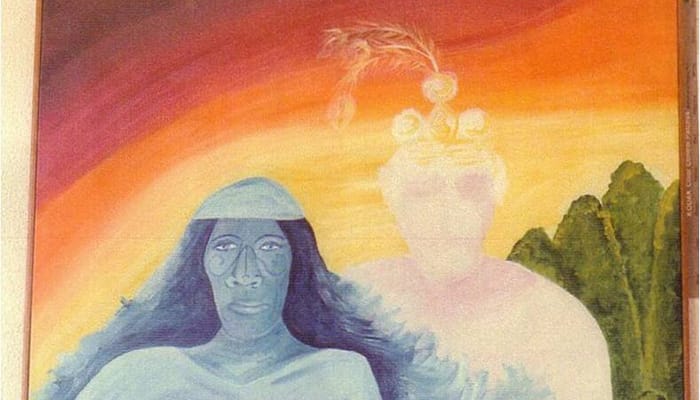
Deep in the Guajira desert, near the Colombian and Venezuelan borders, lies a traditional, historic, and indigenous community known in Wayuu mythology as the people of the sun, sand, and wind: the Wayuu tribe. They arrived in Guajira from the Amazon rainforest and the Antilles in 150 AD.
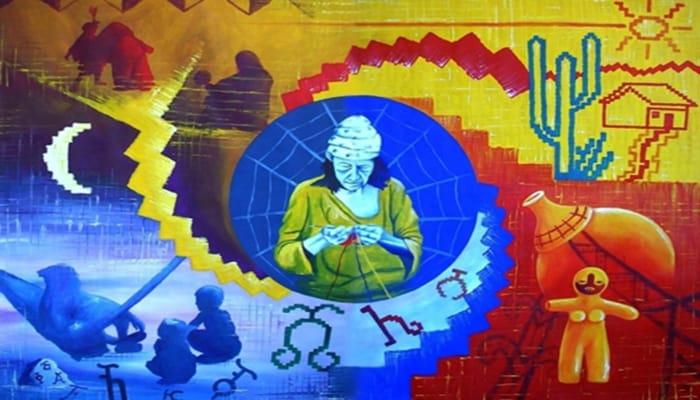
the Arawak-speaking Wayuu who live around Maracaibo in Venezuela and on both sides of the border with Colombia on the Guajira Peninsula are also known as Guajiros. They are the largest indigenous group in Venezuela and have preserved a rich tradition of Wayuu myths, as well as their own shamanic traditions and funeral practices. These Wayuu myths speak about the nature of the soul and the cause of death.
To escape hostile environments and find a new home, the Wayuu have fought (the Spanish, the government, and, currently, Mother Nature) to keep their traditions alive.
1. Wayuu Myths: Kasipoluin the Rainbow
The first of the Wayuu myths taken from Michel Perrin’s book “El Camino de Los Indios Muertos” (The Way of the Dead Indians) explains the origin of the rainbow known as Kasipoluin, and the connection between Kasipoluin and Juya, the rain. Without Kasipoluin, the rainbow, it would rain incessantly. Wayuu myths say that the rainbow came to tell Juya, the rain, to stop.

In Wayuu mythology, it is believed that the rainbow appears at the same time as Juya to tell her to stop, saying, “Don’t rain anymore, Juya.” Wayuu myths explain that the rainbow has the voice of a snake that lives underground. What comes out of its mouth looks like smoke and has three points: green or blue, yellow, and red.
According to Wayuu myths, the guajiros say that snakes are the enemies of Juya and Juya (the rain) is the adversary of snakes. Juya (the rain) strikes them with her lightning bolts when she sees the snakes. Some people say that the rainbow always comes from the boa known as Sarulu. Other Wayuu myths say that it can come from any snake, or an iguana or the caiman, known as Maliwa.
2. Wayuu Myths: The Origin of Fire
Wayuu mythology includes a story about the origin of fire. This Wayuu myth not only recounts the exploits of a brave and ingenious hero named Junuunay stealing fire from the cave of the creator god Maleiwa, like the Greek myth of Prometheus, but also the origin of the firefly, the beetle, and the sikiyu bird.

This Wayuu myth says that at the beginning of creation, people did not have fire. They were imperfect creatures who ate raw things: meat, vegetables, roots, and wild fruits. They did not cook vegetables over a fire. They did not eat prepared food. Meat was not smoked or roasted. They hung their food in the sun and ate it dry.
These first people, because of their imperfection, shared their sad fate with the animals. Some lived in tree trunks, some in caves, some in holes. Others had huts for shelter but lived without fire to warm them or give them light to avoid fear in the darkness of the night.
As the Wayuu myth tells:
Act I: Maleiwa and fire
Maleiwa (the Wayuu creator god) was the only one who possessed fire. He had some burning stones that he kept jealously in a cave far from the reach of people. Maleiwa did not want to give fire to people because they lacked judgment. Instead of using it for good, they might use it in bad ways to set fire to the brush, burn living creatures, and hasten calamities. That is why he hid it from them.
But one day, when Maleiwa was standing by the fire warming his body, a young man named Junuunay came toward him, stiff with cold.
The god, seeing him approach, became angry and said:
“Why have you come, intruder?Don’t you know that all access to this place is forbidden?Perhaps you have come to disturb my peace and test my patience?”
Junuunay replied, pleadingly:
” No, venerable grandfather. I have only come to stand by your side and warm my body. Have mercy on me. It was not my intention to offend you. Protect me from this cold that freezes me, pricks my skin, and penetrates my bones. As soon as I am warm, I will leave.”
Junuunay hid his intentions while saying this. The bold young man used a series of clever tricks to convince Maleiwa. He gritted his teeth, made his pores bristle as if he had goose bumps, shivered like a male lizard, and rubbed his hands together until, finally, Maleiwa took pity on him and agreed.
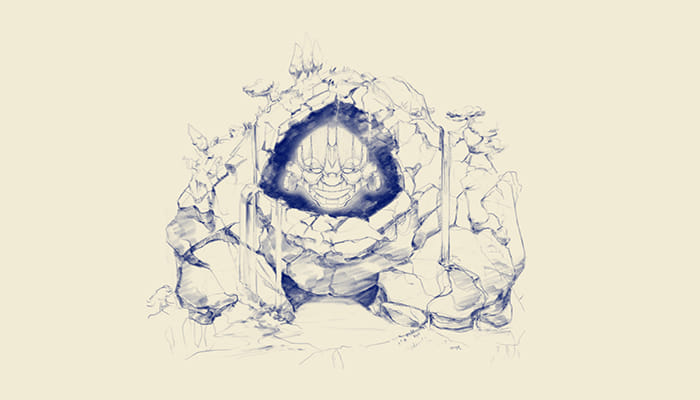
Act II: Junuunay steals the fire
But the Great Father did not take his eyes off him, because he had his doubts about the honesty of this stranger, who inspired admiration rather than contempt.
Both began to rub their hands together and warm their bodies. The flames of that fire were intensely beautiful, emitting a glow that could be seen from afar like the golden glow of the stars, like the burning embers of the sky.
Junuunay’s courage grew, and he tried to speak to Maleiwa to distract him, but Maleiwa remained silent and did not notice the stranger’s words.
But suddenly Maleiwa turned his gaze backward upon hearing a strange noise. It sounded like small, cautious footsteps rustling through the dead leaves.
Junuunay took advantage of Maleiwa’s carelessness to grab two burning embers and put them in a small hidden bag. With that, he fled, slipping away into the undergrowth surrounding the cave.
Act III: Junuunay’s punishment
The Great Maleiwa, realizing that a theft had taken place and that he had been deceived, rushed after Junuunay to punish him.
Maleiwa said:
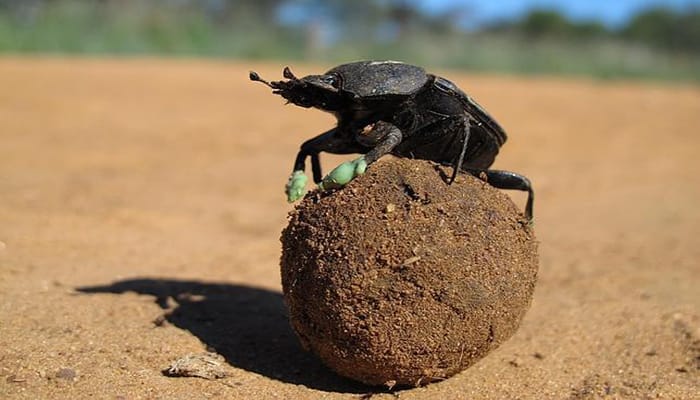
” That rascal tricked me. I will punish him, I will torture him with a life of filth. I will make him live in a pigsty, in a pile of manure, pushing balls of manure…”
And with that, he ran after the thief.
Junuunay ran desperately to escape, but his steps were so slow and short that he could barely move forward. Trapped in this difficult situation, he once again used his slippery skill to save himself. He called a young hunter named Kenaa to help him, and quickly passed him one of the burning coals to hide. Kenaa took the precious flaming jewel and ran away unseen.
To punish him, Maleiwa turned him into a firefly, which emits a flickering light when it flies through the dark winter nights.
Junuunay, exasperated, found Jimut, the grasshopper, and said to him:
“My friend, the god Maleiwa is harassing me because I took the fire from him to give it to the people. Take this last burning ember, flee with it, and hide it in a safe place, because whoever possesses this jewel will be the luckiest, wisest, and greatest person of all.”
Act IV: The people find fire
Saying this, Jimut took the burning coal and quickly hid it inside a branch of the Cuajaro tree, then moved it to an olive tree and then to a branch of another tree; and it spread and multiplied everywhere.
The people discovered it later through a boy named Serumaa. This boy, while playing and jumping around the bush, showed the people the wood in which Jimut had placed the fire.
That child could not speak, he only knew how to say: Skii… Skii… Skii… Fire… Fire… Fire… The people rushed to find the fire but could not find it. And they did not know how to get it. They searched all the trees, branches, and trunks, but could not find anything.
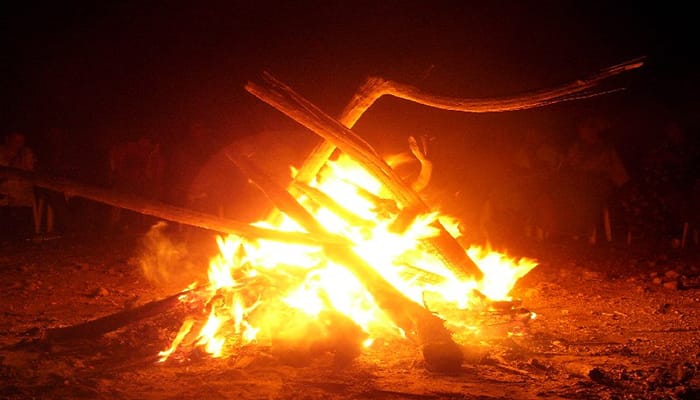
Then they saw Jimut drilling a hole in a branch, and following his example, they drilled and rubbed two sticks from the Caujaro tree with their hands, and a flame appeared at the tip, illuminating the heart of the field and filling the spirits of the people with happiness.
Since then, they have used fire. Now the people are no longer afraid and no longer have to suffer the harshness of the cold night.
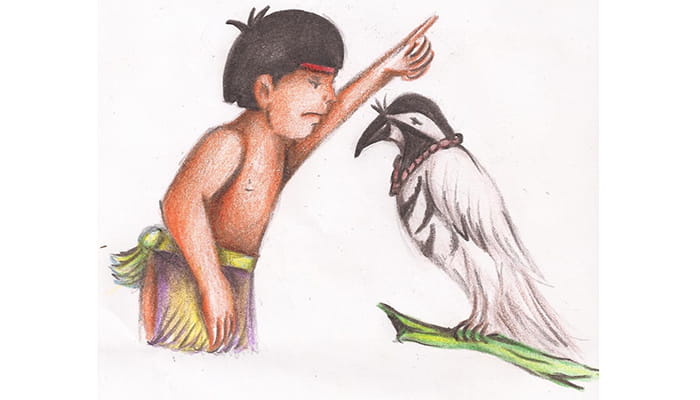
Maleiwa turned the young Serumaa into a little bird that jumps from branch to branch crying Ski… Ski… Ski. Since then, Serumaa has been called Sikiyuu.
This happened after Maleiwa turned Junuunay into a beetle and condemned him to live in filth for stealing fire.
Since then, the beetle has lived and fed on excrement. And as punishment for his audacity, marked on his body are the marks of his theft, that is, the shiny marks that beetles have on their legs.
3. Wayuu Myths: Pulowi of the Earth and Pulowi of the Sea
This is another Wayuu myth taken from Michel Perrin’s book “El Camino de los Indios Muertos” (The Way of the Dead Indians). It tells the story of two of Juya’s wives, Pulowi of the Earth and Pulowi of the Sea, who are fierce goddesses of nature. Juya, a hunter who controls the rain, married Pulowi but then left her for Mma, who gave birth to plants.
That is why the despised Pulowi is so dangerous to people today. Wayuu myths say that she can turn those who look at her into stone, or seduce them in the form of a beautiful woman and then devour them.